Why Your Desk Job Could Be Causing Neck Pain (And What You Can Do About It)
Written by Dr Julian Simpson — Chiropractor with 15+ years of experience, Board Member of the Chiropractic Australia Research Foundation, and author/reviewer of 800+ health articles.
Why Your Desk Job Could Be Causing Neck Pain (And What You Can Do About It)
Sitting at a Computer All Day? Your Muscles Might Be Paying the Price
If you spend your day in front of a computer, there's a good chance you've experienced that familiar tightness across your shoulders, an aching neck by the afternoon, or a nagging headache that seems to appear after a long day at work.
Whether you're commuting from Sunbury into Melbourne along the Calder Freeway, travelling from Melton via the Western Highway, or working from home at your kitchen table, hours spent sitting in the same position can gradually overload your muscles without you even realising it.
The good news? New research has identified exactly which muscles are most affected—and, more importantly, what can be done to reduce your risk of ongoing pain.
What Are Trigger Points?
You may have heard people describe them as "muscle knots."
Clinically, they're known as myofascial trigger points (MTrPs)—small, highly sensitive spots within tight bands of muscle that can:
Cause local pain
Refer pain to other areas
Restrict movement
Create muscle weakness
Contribute to headaches
Lead to persistent neck and back pain
These trigger points often develop when muscles remain under low-level tension for long periods—exactly what happens during prolonged computer work.
What Did the Research Find?
A large 2025 study involving 305 office workers who used computers for at least four hours every day investigated how common active trigger points are in people with desk-based jobs.
The findings were eye-opening.
The Most Common Problem Areas
Researchers found active trigger points in:
40% of workers in the right upper trapezius
35% in the left upper trapezius
20% in the right sternocleidomastoid (the large muscle running down the side of the neck)
18% in the left sternocleidomastoid
23% in the right infraspinatus (back of the shoulder)
20% in the left infraspinatus
The upper trapezius—the muscle between your neck and shoulder—was by far the most commonly affected.
If you've ever rubbed the top of your shoulder after work, you've probably found exactly where this muscle sits.
Women Were Affected More Often
The study found women experienced active trigger points much more frequently than men.
For example:
Right Upper Trapezius
54% of women
23% of men
Left Upper Trapezius
48% of women
18% of men
Right Sternocleidomastoid
28% of women
9% of men
Researchers believe this may be due to several factors, including:
Different pain sensitivity
Workstation design often based on average male body dimensions
Greater cumulative physical and mental workload
Increased muscle tension associated with stress
Why Does Sitting Cause So Much Pain?
When you sit at a computer for hours, several things happen:
Your head gradually moves forward.
Your shoulders round.
Neck muscles work continuously to support the weight of your head.
Shoulder muscles remain contracted for long periods.
Blood flow reduces.
Muscles fatigue.
Sensitive trigger points begin to develop.
Even though the muscles aren't lifting heavy weights, they're working continuously without adequate recovery.
Over weeks and months, this constant low-level contraction becomes painful.
It's Not Just Neck Pain
Trigger points don't always hurt where they develop.
They often create referred pain, meaning discomfort is felt somewhere else.
For example:
Upper Trapezius Trigger Points
May cause:
Neck pain
Shoulder tightness
Tension headaches
Pain behind the eyes
Sternocleidomastoid Trigger Points
May contribute to:
Headaches
Facial pain
Dizziness
Pain around the ear
Eye discomfort
Lower Back Trigger Points
Can produce pain into:
Buttocks
Hips
Pelvis
Upper leg
This is one reason many people struggle to identify where their pain is actually coming from.
Disability Matters More Than Age
One particularly interesting finding was that your level of pain and disability predicted trigger points much better than your age.
Researchers used two well-established questionnaires:
Neck Disability Index (NDI)
Oswestry Disability Index (ODI)
Higher scores on these assessments significantly increased the likelihood of having active trigger points.
In simple terms:
The more neck or back problems people already had, the more likely they were to develop painful muscle trigger points.
Stronger, Healthier Muscles Offer Protection
Researchers also measured something called the Pressure Pain Threshold (PPT) using a device known as an algometer.
This measures how much pressure a muscle can tolerate before becoming painful.
People with higher pressure pain thresholds were much less likely to have active trigger points.
In some neck muscles, every increase in pressure tolerance dramatically reduced the chance of developing painful trigger points.
This suggests healthier, stronger muscles are naturally more resilient.
Why a Holistic Approach Works Best Trigger points rarely develop because of just one factor. Successful long-term management usually combines several approaches: Chiropractic care to improve spinal movement and joint function Soft tissue therapy to reduce muscle tension Targeted strengthening exercises Ergonomic workstation improvements Regular movement throughout the day Education about posture and healthy work habits Treating only the painful muscle often provides temporary relief. Addressing the underlying movement patterns and lifestyle factors is much more likely to produce lasting improvements.
What Strengthening Programme Did the Researchers Recommend?
Unlike many studies that simply identify a problem, this research also highlighted practical strategies.
The authors recommended targeted strengthening programmes focusing on the:
Neck muscles
Shoulder muscles
Scapular (shoulder blade) stabilisers
Lumbar (lower back) muscles
These muscles help support good posture during prolonged sitting and reduce overload on sensitive tissues.
Examples of beneficial exercises include:
Chin tucks
Scapular retraction ("shoulder blade squeezes")
Resistance band rows
Wall angels
Bird-dog exercises
Glute bridges
Side planks
Dead bugs
Thoracic extension mobility exercises
While the study did not prescribe a specific exercise protocol (such as sets, repetitions or weekly frequency), it consistently concluded that strengthening these muscle groups is likely to reduce neck pain, lower back pain and disability in office workers.
Small Daily Habits Make a Big Difference
You don't need to completely overhaul your workstation overnight.
Start with a few simple habits:
Every 30–45 minutes:
Stand up.
Walk for 1–2 minutes.
Stretch your chest.
Roll your shoulders.
Reset your posture.
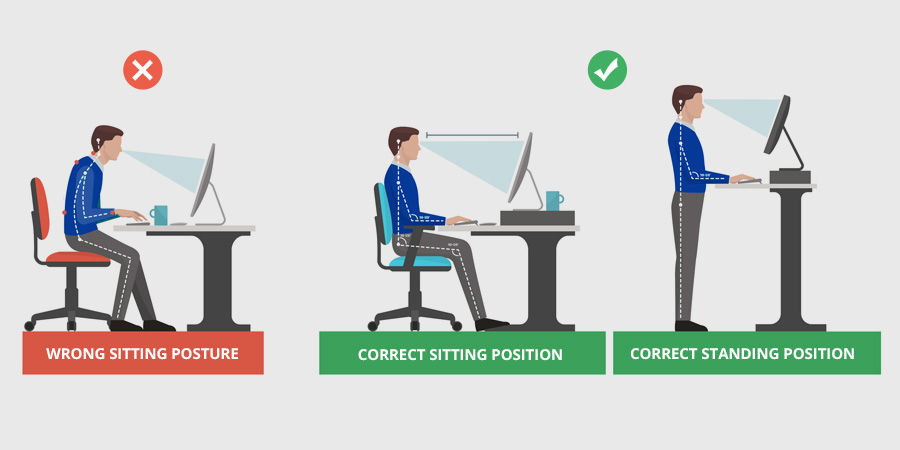
Position your screen correctly
Aim for:
Top of monitor at eye level
Screen about an arm's length away
Elbows around 90 degrees
Feet flat on the floor
Build Strength
Two to three strengthening sessions each week can help improve muscle endurance and reduce the strain caused by prolonged sitting.
Don't Ignore Early Symptoms
Persistent:
neck stiffness
shoulder tightness
headaches
upper back pain
are often early warning signs—not something you simply have to live with.
Can Chiropractic Care Help?
While this particular study focused on identifying trigger points rather than testing treatments, its findings reinforce what many healthcare practitioners see every day: prolonged sitting, muscle overload and reduced movement contribute significantly to neck and back pain.
For many people, chiropractic care forms part of a broader management plan by helping to:
Improve spinal mobility
Reduce joint stiffness
Address movement dysfunction
Support healthy posture
Work alongside exercise rehabilitation and ergonomic advice
When combined with strengthening exercises, movement education and healthy workplace habits, this integrated approach may help reduce pain and improve day-to-day function.
The Takeaway
Modern office work places enormous demands on our muscles. This study found that 4 in every 10 office workers had active trigger points in the upper trapezius, with women particularly affected. Neck and back disability were strong predictors of these painful muscle knots, while healthier, stronger muscles appeared to offer significant protection.
If you spend long hours at a desk and regularly experience neck pain, shoulder tension or headaches, it may be time to look beyond simply "putting up with it". Early assessment, targeted strengthening, regular movement and appropriate hands-on care can all play an important role in helping you stay comfortable, productive and active.
How Chiropractic Care May Help
At Health Wise Chiropractic, we take a comprehensive approach to posture-related care.
Treatment may include:
We focus on addressing both the symptoms and the underlying biomechanical stress contributing to neck dysfunction.
About the Author
Dr Julian Simpson is an Australian chiropractor with over 15 years of experience in musculoskeletal healthcare and rehabilitation.
He is a Board Member of the Chiropractic Australia Research Foundation and has reviewed and written more than 800 evidence-based health articles focused on spinal health, rehabilitation, sports injuries and conservative care approaches.
His treatment focus includes:
Chiropractic adjustments
Sports chiropractic
Massage therapy
Shockwave therapy
Laser therapy
Non-surgical spinal decompression
Dr Simpson provides patient care through Healthwise Chiropractic, serving communities including Sunbury, Melton, Diggers Rest and surrounding regions.

Reference
Poveda-Pagán EJ, Lozano-Quijada C, Hernández-Sánchez S, Toledo-Marhuenda JV, Pintado EL, Segura-Heras JV, Gascón-Jaén J. Prevalence and Predictive Factors of Active Myofascial Trigger Points Among Office Workers Using to Visual Display Terminals: A Cross-Sectional Study. Arch Rehabil Res Clin Transl. 2026 Feb 26;8(2):100606. doi: 10.1016/j.arrct.2026.100606. PMID: 42326585; PMCID: PMC13282818.


Comments