When the Room Spins: Understanding BPPV, Dizziness, and How Modern Chiropractic Care Helps You Get Your Balance Back
Written by Dr Julian Simpson — Chiropractor with 15+ years of experience, Board Member of the Chiropractic Australia Research Foundation, and author/reviewer of 800+ health articles.

When the Room Spins: Understanding BPPV, Dizziness, and How Modern Chiropractic Care Helps You Get Your Balance Back
The everyday frustration no one talks about
If you’ve ever rolled over in bed and suddenly felt the room spin… or stood up from the couch and had to grab the wall just to steady yourself… you’ll know how unsettling dizziness can be.
For many people across Sunbury and Melton—especially those doing long drives along the Calder Freeway or Western Highway, working at a desk all day, or juggling busy family routines—these episodes often get brushed off as “just stress” or “getting up too fast”.
But when it keeps happening, it stops being minor. It starts affecting confidence, movement, sleep, and even safety.
One of the most common culprits behind these symptoms is a condition called benign paroxysmal positional vertigo (BPPV)—a mechanical issue in the inner ear that creates brief but intense spinning sensations with head movement.
What’s actually happening in BPPV?
Inside your inner ear are tiny calcium carbonate crystals (otoconia) that normally help your brain understand gravity and movement.
Sometimes—due to aging, head injury, migraines, or even prolonged inactivity—these crystals shift into the wrong part of the balance system (the semicircular canals). When your head moves, they “misfire” your balance signals.
That mismatch is what creates the sudden spinning sensation.

Typical features include:
Vertigo lasting seconds to minutes
Triggered by rolling in bed, looking up/down, or standing quickly
No hearing loss or persistent neurological symptoms
A brief delay before symptoms kick in (often a few seconds)
Importantly, dizziness is common—around 15% of adults experience balance or dizziness issues, making it one of the most frequent reasons people seek urgent or primary care review.
Why dizziness matters more than most people realise
While BPPV itself is usually benign, untreated balance disorders can significantly impact quality of life and increase fall risk—particularly in older adults.
And dizziness is not always straightforward. It can overlap with:
Medication side effects
Cardiovascular or neurological conditions
That’s why careful assessment is essential—especially when symptoms are new, severe, or changing.
What the research says about modern conservative care
Spinal and musculoskeletal care is strongly evidence-supported
While BPPV is treated with specific repositioning manoeuvres, broader dizziness and neck-related symptoms often sit within a musculoskeletal and neuro-mechanical system.
For low back and spinal pain—which frequently co-exists with dizziness and balance issues—research is very clear:
Low back pain accounts for around 24% of global disability-adjusted life years linked to workplace ergonomic strain (Ead et al., 2024)
Clinical Practice Guidelines show ~90% recommend spinal manipulative therapy (SMT) for low back pain
100% of neck pain guidelines recommend SMT (Trager et al., 2024)
This matters because the neck plays a major role in proprioception (your body’s sense of position in space). When cervical joints and muscles are stiff or irritated, they can contribute to imbalance, dizziness, and “foggy” spatial awareness.
The multimodal approach: why single treatments rarely work best
Modern evidence strongly supports a combined (multimodal) care model, rather than relying on one technique alone.
🟦 Why multimodal care works best Research consistently shows that spinal manual therapy produces the best outcomes when combined with: Individualised rehabilitation exercises Patient education and reassurance Active self-management strategies Postural and movement retraining (Gevers-Montoro et al., 2021; LeFebvre et al., 2012) This approach improves both symptom relief and long-term resilience, rather than just short-term correction.
At Health Wise Chiropractic, this is exactly how we approach balance and spine-related conditions—especially for active locals in Sunbury and Melton who need long-term solutions, not temporary fixes.
Where BPPV fits into chiropractic care
While BPPV originates in the inner ear, not the spine, its symptoms often overlap with musculoskeletal dysfunction—particularly in the neck.
A typical evidence-informed approach includes:
1. Detailed assessment
We look at:
Symptom timing (seconds vs hours vs constant)
Triggers (rolling in bed, looking up/down)
Neck mobility and joint function
Neurological screening to rule out red flags
If BPPV is suspected, positional testing such as:
Dix–Hallpike manoeuvre
Supine roll test

may be used to identify the affected canal.

2. Targeted repositioning techniques (when appropriate)
If BPPV is confirmed, specific head and body manoeuvres are used to guide the displaced crystals back into the correct area of the inner ear.
These can include:
Epley manoeuvre (most common form)
Semont manoeuvre
Log roll techniques for horizontal canal involvement
These procedures are often highly effective, with studies showing success rates between 76% and 93%.

The Semont Maneuver
The Semont maneuver (sometimes called the Liberatory maneuver) relies on rapid momentum. Instead of twisting the head across multiple positions, it moves the entire torso in a swift arc to "sling" the crystals out of the canal. It is highly effective but requires a bit of physical agility.
Step-by-Step Procedure
1. Starting Position:Preparation.
Sit upright on the very edge of a flat bed or examination table, with your legs hanging off the side. Turn your head 45 degrees to the left (away from the bad ear). You will maintain this exact head angle relative to your body for the rest of the procedure.
2.Drop to the Affected Side:Hold for 1–2 minutes.
Swiftly lie down onto your right side (the affected side). Because your head is turned left, you will end up lying on your side looking up toward the ceiling. Expect strong vertigo. Stay perfectly still for 1 to 2 minutes until the crystals settle.
3.The Rapid Swing:Hold for 1–2 minutes.
In one rapid, fluid motion taking less than 2 seconds, swing your entire upper body up and all the way over to your left side. Do not change your head position. You will land on your left side with your face and nose pointing straight down into the bed. Hold this position for 1 to 2 minutes.
4.The Return to Upright:Final Step.
Slowly push yourself back up into a normal sitting position on the edge of the bed. Keep your head straight and level.
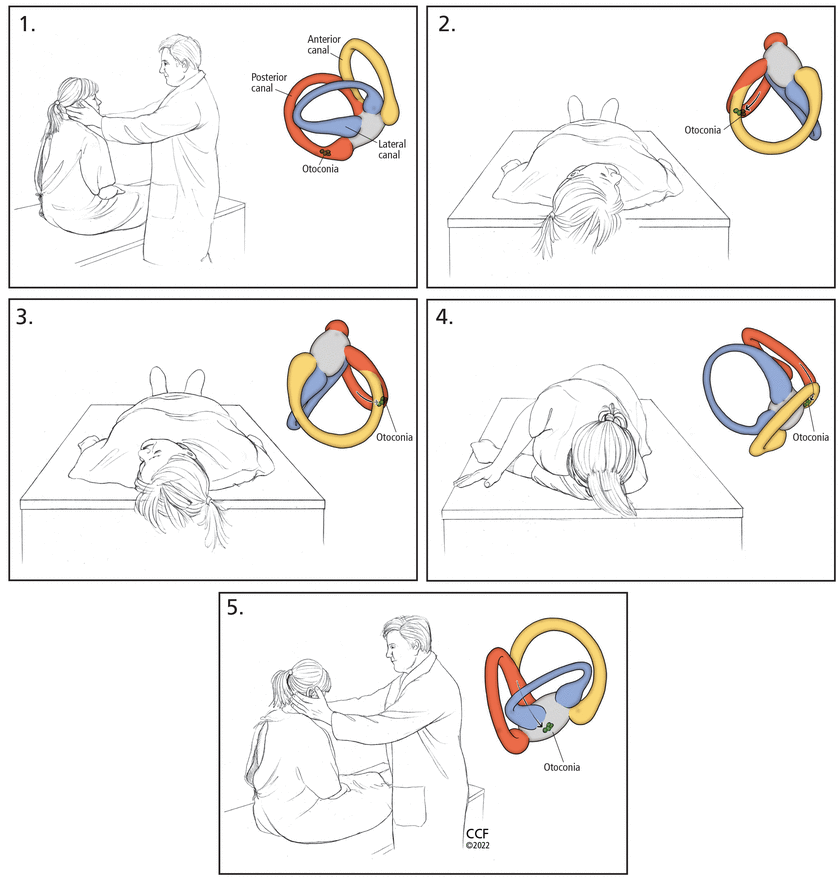
The Epley Maneuver
The Epley maneuver is a gradual, sequential rotation. It is excellent for most patients, particularly those who have limited mobility or cannot tolerate rapid, jarring movements.
Step-by-Step Procedure
1.Starting Position:Preparation.
Sit completely upright on a bed or treatment table. Place a pillow behind you so that when you lie backward, the pillow will rest beneath your shoulders, allowing your head to extend slightly off the edge.
2.The First Turn:Hold for 30–60 seconds.
Turn your head 45 degrees to the right. Keep your eyes open. Quickly lie flat on your back so your shoulders rest on the pillow and your head is reclined backward at a 20-degree angle. Vertigo will likely trigger here. Wait for the spinning to completely stop, plus an extra 30 seconds.
3.The Second Turn:Hold for 30–60 seconds.
Without raising your head or neck, slowly rotate your head 90 degrees to the left (so you are now looking 45 degrees to the left side). Hold this position until any dizziness subsides, plus an extra 30 seconds.
4.The Body Roll:Hold for 30–60 seconds.
Roll your entire body onto your left side, keeping your head turned relative to your torso. Your face should now be angled downward toward the mattress or floor at a 45-degree angle. Hold this position until all spinning stops, plus 30 seconds.
5.The Return to Upright:Final Step.
Carefully bring your legs over the edge of the bed and push yourself sideways up into a normal sitting position. Do not look up or down right away; keep your chin slightly tucked.
3. Neck and postural rehabilitation
Because cervical dysfunction can amplify dizziness symptoms, care may include:
Gentle spinal mobilisation or SMT
Deep neck stabiliser strengthening
Balance and gaze stability exercises
Postural retraining (especially for desk workers and drivers)
4. Education and reassurance
Understanding what is happening physiologically is often a major part of recovery. Many patients find that once they understand BPPV is mechanical—not dangerous—the anxiety around symptoms reduces significantly.
Is it safe?
Yes—when appropriately assessed.
Research consistently shows that conservative manual therapies have a strong safety profile, with serious complications being extremely rare (Breen et al., 1999). This is especially important when compared with long-term use of certain medications for dizziness or pain, which carry well-documented risks when used continuously.
Safety always begins with proper screening to ensure symptoms are not coming from vascular, neurological, or other systemic causes.
A practical care pathway for patients
A typical evidence-based approach may look like:
Clinical history focusing on the dizziness pattern and triggers
Neurological and cardiovascular screening if needed
Positional testing (Dix-Hallpike / roll tests)
Repositioning manoeuvres if BPPV is confirmed
Cervical spine assessment for contributing dysfunction
Multimodal rehab plan (manual therapy + exercise + education)
Referral if symptoms do not match BPPV patterns or don’t respond as expected
When to seek help
You should get assessed if you experience:
Recurrent spinning when lying down or turning in bed
Sudden dizziness when looking up or bending forward
Ongoing imbalance after an episode
Neck stiffness alongside dizziness
Symptoms affecting driving or daily activities
How Chiropractic Care May Help
At Health Wise Chiropractic, we take a comprehensive approach to posture-related care.
Treatment may include:
We focus on addressing both the symptoms and the underlying biomechanical stress contributing to neck dysfunction.
About the Author
Dr Julian Simpson is an Australian chiropractor with over 15 years of experience in musculoskeletal healthcare and rehabilitation.
He is a Board Member of the Chiropractic Australia Research Foundation and has reviewed and written more than 800 evidence-based health articles focused on spinal health, rehabilitation, sports injuries and conservative care approaches.
His treatment focus includes:
Chiropractic adjustments
Sports chiropractic
Massage therapy
Shockwave therapy
Laser therapy
Non-surgical spinal decompression
Dr Simpson provides patient care through Healthwise Chiropractic, serving communities including Sunbury, Melton, Diggers Rest and surrounding regions.

reference Cole SR, Honaker JA. Benign paroxysmal positional vertigo: Effective diagnosis and treatment. Cleve Clin J Med. 2022 Nov 1;89(11):653-662. doi: 10.3949/ccjm.89a.21057. PMID: 36319052.


Comments